Before you write a single word of copy, you have to decide what you want to say.
“Of course we know what we want to say. We’re going to tell people why they need our product!” Right?
WRONG.
Okay, generally right. But there’s way more to it than that.
Get the “what” step right, and you’ll find that every aspect of your marketing – and sales, and customer service – suddenly gets easier. And I’ll tell you exactly how to do it.
Have you heard of Donald Miller’s StoryBrand approach? I cannot overstate how magical this exercise is.
No affiliate links, I just love StoryBrand that much. In fact, you can probably find Miller’s book at your local library and go through the whole thing without buying any of it. I listened to the audiobook on Libby, an app that lets you read and listen to thousands of books for free by connecting your library card.
I highly recommend going through the exercise with the help of the book or an official workshop. But just to whet your whistle, here’s a summary of the framework along with my own suggestions based on my experience implementing it.

The StoryBrand framework
This methodology uses storytelling principles to help brands clarify their message. Here are a few foundational tenets of StoryBrand:
- Your customer is the hero of the story, not your brand.
- Companies tend to sell solutions to external problems, but customers buy solutions to internal problems.
- Customers aren’t looking for another hero; they’re looking for a guide (that’s you).
- Customers trust a guide who has a plan.
- Customers do not act unless called upon to act.
- Every human being is trying to avoid a tragic ending.
- Never assume people understand how your brand can change their lives. Tell them.
If you’re familiar with any sort of “hero’s journey” storytelling framework, this paradigm won’t be new to you. What’s special about StoryBrand is that it walks you through identifying 12 specific elements of your brand’s story. This is not a theory book – by the time you finish it, you’ll have your completed brand script, ready to use.
And boy, will you use it.
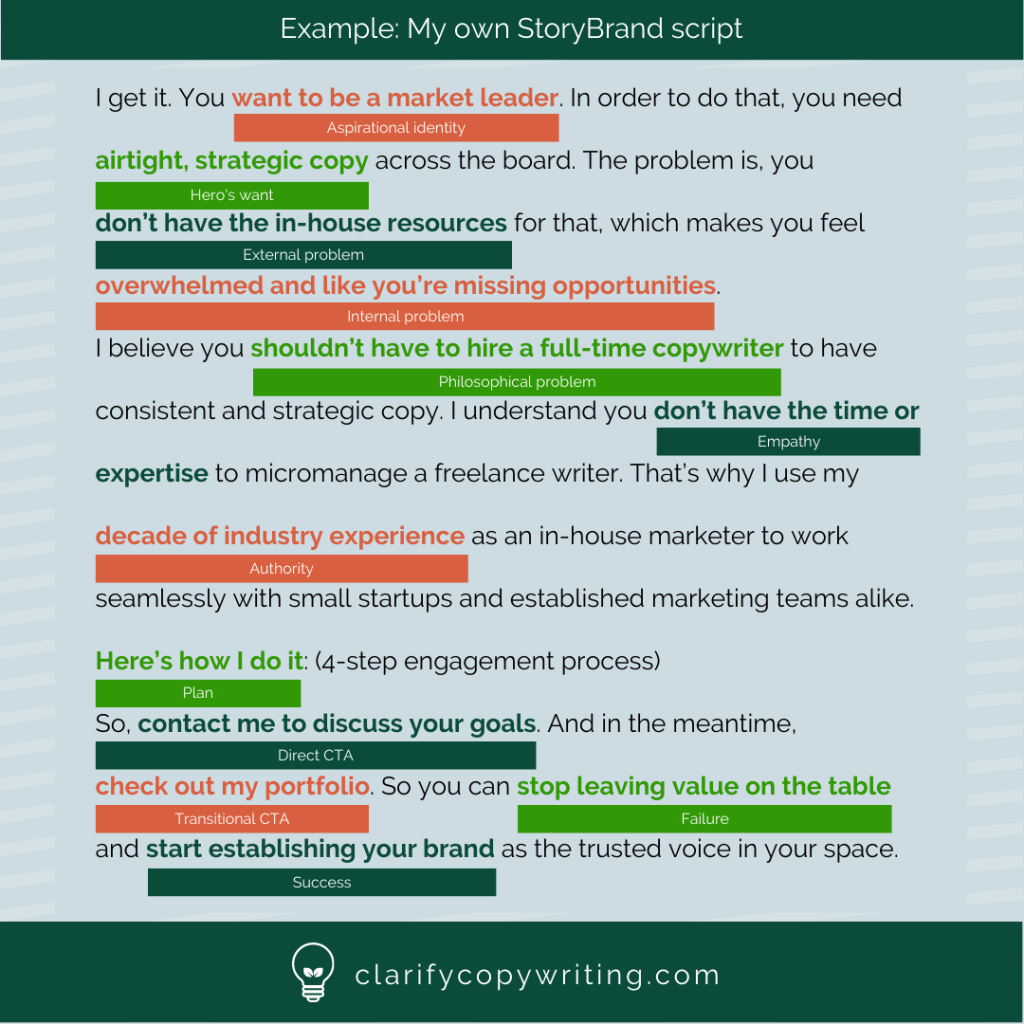
Here are the elements of the script:
- Aspirational identity: Who the hero wants to be
- Hero’s want: Their bottom-line goal
- External problem: Face-value problem the hero is trying to solve
- Internal problem: Underlying emotions and main reason the hero will act
- Philosophical problem: Why the hero’s current situation is just plain wrong
- Empathy: Necessary trait for the hero to trust the guide
- Authority: Another necessary trait
- Plan: 3 to 5 easy next steps for the hero
- Direct CTA: Most valuable action the hero could take
- Transitional CTA: Softer CTA for heroes who aren’t ready for direct CTA
- Failure: What will happen if the hero doesn’t act
- Success: Benefits the hero will get from acting
I’ve developed a couple of brand scripts and while it can feel nebulous starting out… when it clicks, you’ll know it. You’ll feel it. Your eyebrows will start to rise and you’ll think “oh shit, that’s right. That’s exactly it.”
In transparency, I’ve shared my own personal script below. It’s not a secret – because it’s already public everywhere my brand is present. I’ve used it to develop my own website copy, my LinkedIn profile, and my presence on freelancer sites.
The reason I love the StoryBrand exercise so much is that it’s all about your ICP. It doesn’t rely on demographics or assumptions. It digs deep into how they think and feel. It’s not about you. It’s about your ICP.
And with that deep understanding of your ICP’s psychology, you know exactly how to speak to them to motivate them to act.
Curious about how a brand story can help you develop way better copy in way less time? Let’s chat.
 Clarify | Copywriting and Content Strategy